How to Build a Household Budget That Actually Works
A household budget is a map for your money, not a restriction. Learn the 50/30/20 framework, how to divide expenses into needs, wants, and savings, and the three-account system that makes it automatic.

What is a household budget?
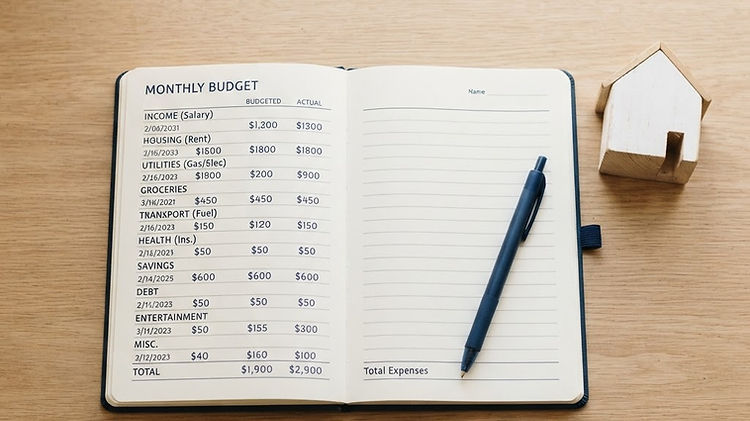
A household budget is a plan for how your household income is spent. It's not a restriction — it's a map. Without one, you're guessing where your money goes and hoping there's enough. With one, you know exactly what's coming in, what's going out, and what's left for the things you want.
The most common budgeting mistake is making it too complicated. A 15-category spreadsheet with formulas for every cent is impressive but unsustainable. A simple budget with five or six categories that you actually follow is far more effective.
This guide walks through a simple, practical approach to household budgeting.
The 50/30/20 framework
A useful starting framework is the 50/30/20 rule, popularised by US senator Elizabeth Warren. It divides your after-tax income into three buckets:
- 50% needs — housing, food, bills, transport, insurance, minimum debt repayments
- 30% wants — entertainment, dining out, hobbies, holidays, non-essential shopping
- 20% savings — emergency fund, savings goals, extra debt repayment, investments
Is 50/30/20 realistic in Australia?
For many Australian households, especially in major cities, 50% for needs is tight. Housing alone can be 30–40% of after-tax income. If your needs exceed 50%, adjust the framework — the principle (needs, wants, savings) is what matters, not the exact percentages.
A more realistic split for high-housing-cost areas might be 60/25/15 or even 65/20/15. The key is that all three buckets are funded, and the savings bucket isn't zero.
Step 1: Know your income
Start with your after-tax household income — the money that actually lands in your account. Include:
- All income sources — salaries, casual work, government benefits, child support, investment income
- Both partners' income if you're budgeting as a couple
- Regular overtime or bonuses only if they're reliable. Irregular income should be budgeted conservatively.
If your income varies (casual, freelance, seasonal), use your average over the last 6–12 months, or be conservative and use a lower month as your baseline.
Step 2: List your expenses
Divide your expenses into the three buckets:
Needs (50–65%)
- Housing: rent or mortgage, rates, body corporate, home insurance
- Utilities: electricity, gas, water, internet, phone
- Food: groceries (not dining out)
- Transport: fuel, public transport, car registration, car insurance, servicing
- Insurance: health, life, income protection
- Minimum debt repayments: credit card minimums, personal loan minimums, HECS
- Childcare and education: fees, before/after school care
Wants (20–30%)
- Dining out and takeaway
- Entertainment: streaming, movies, concerts, nights out
- Hobbies and sport: gym, equipment, memberships
- Holidays and travel (not sinking funds — those are needs)
- Non-essential shopping: clothing beyond basics, gadgets, gifts
- Personal care: haircuts, beauty, treatments beyond basics
Savings (15–20%)
- Emergency fund — until you have 1–3 months of expenses
- Savings goals — house deposit, holiday, car, sinking funds
- Extra debt repayment — above minimums, especially for high-interest debt
- Investments — super contributions, shares, index funds
Step 3: Calculate the split
Add up each bucket and calculate the percentage:
Example: $4,000/month after tax
| Bucket | Amount | % | |---|---|---| | Needs | $2,600 | 65% | | Wants | $800 | 20% | | Savings | $600 | 15% |
In this example, needs are high (likely due to housing), so wants and savings are compressed. This is common in Australian cities. The budget is still healthy — all three buckets are funded, and savings is 15%.
If the numbers don't work
If your needs exceed 65–70% of income, the budget is under pressure. Three options:
- Increase income. Side income, a raise, a job change, or taking on a housemate.
- Reduce needs. The hardest but most impactful: cheaper housing (move, housemate, refinance), reduce bills (negotiate, switch), reduce transport costs.
- Accept a tight period. If the situation is temporary (studying, early career, paying off debt), a high-needs budget may be necessary for now. Set a timeline for when it will change.
Step 4: Set up the system
A budget only works if it's easy to follow. The simplest system:
The three-account method
- Everyday account — for wants and variable spending. This is what you live on day to day.
- Bills account — for needs. Transfer the total monthly bills amount here on payday. See our guide to managing household bills.
- Savings account — for savings and sinking funds. Transfer the savings amount here on payday, before anything else.
On payday:
- Transfer savings to the savings account (pay yourself first)
- Transfer the bills total to the bills account
- What's left in the everyday account is your wants money for the period
This system works because it's automatic and separates the money. You don't have to make decisions about whether to save — it happens first. You don't have to worry about bills — the money is set aside. What's in your everyday account is genuinely yours to spend.
Step 5: Track and adjust
A budget is not set-and-forget. Review it:
- Monthly. Check that your actual spending matches your plan. If one category is consistently over, adjust the budget or the spending.
- Quarterly. Review the big picture. Are your savings growing? Are you on track for your goals? Is the split still working?
- When circumstances change. A new job, a move, a new bill, a pay rise — all require a budget update.
How to track
You don't need a complicated spreadsheet. Two options:
- The accounts tell the story. If you're using the three-account method, the balances tell you whether you're on track. Savings growing, bills account covering bills, everyday account not overdrawn — you're winning.
- A simple tracker. A notebook, a notes app, or a budgeting app. Record major expenses and check monthly.
The Payday Compass app handles this automatically — enter your income, bills, and savings goals, and it projects your balance forward, showing your available money and whether you're on track.
Budgeting as a couple
If you're budgeting with a partner, alignment matters more than the system:
- Agree on the framework. Both partners need to agree on the needs/wants/savings split and the amounts.
- Have regular money conversations. A 15-minute monthly review prevents resentment and surprises.
- Allow individual spending money. Each partner should have a small amount of no-questions-asked spending money. This prevents arguments about small purchases.
- Be transparent. Both partners should have full visibility of all accounts and the budget. Financial secrecy destroys trust.
Common budgeting mistakes
- Making it too complicated. A simple budget you follow beats a complex one you don't. Start with 5–6 categories.
- Budgeting for the ideal, not the real. If you spend $200/week on groceries, budgeting $150 sets you up to fail. Start with reality.
- Forgetting irregular expenses. Annual and quarterly bills need to be included. See our guide to planning for annual bills.
- No savings category. If savings is "whatever's left," there's usually nothing left. Pay yourself first.
- Never adjusting. A budget that worked 2 years ago may not work now. Review and update regularly.
- Giving up after a bad month. One bad month doesn't mean the budget failed. Adjust and continue.
Summary
A household budget is a map for your money: know your income, divide expenses into needs, wants, and savings, set up a system that separates the money automatically, and track and adjust regularly. The framework is simple — the discipline is in setting it up and letting it run. Start with the 50/30/20 rule (adjusted for your housing costs), use the three-account method, and review monthly. A budget that works is one you actually follow, not one that looks impressive on paper.
To build and track a household budget with runway projections, try the Payday Compass Money Runway. For a quick check on your available money, use the free payday calculator.
Put it into practice
The Payday Compass workbook brings these ideas together in one organised spreadsheet.
Explore the Budget Planner