How to Set a Savings Goal You'll Actually Reach
Most savings goals fail because they're wishes, not plans. Learn the five-step system to set a goal with a specific amount, a deadline, a per-pay contribution, and a separate account — and actually reach it.


Why most savings goals fail
Most savings goals fail for the same reason: they're wishes, not plans. "I want to save $5,000" is a wish. "I'll put $95 into a separate account every Friday for 12 months" is a plan.
The difference matters because a wish lives in your head and competes with every other thing you want to spend money on. A plan sits in an account and happens automatically. This guide walks through how to turn a savings wish into a goal you'll actually reach.
Step 1: Pick one goal at a time
The first mistake is trying to save for everything at once — a holiday, a house deposit, a new car, an emergency fund, Christmas. When you spread $200 across five goals, each one moves so slowly it feels pointless, and you lose motivation.
Instead, pick one goal to focus on first. If you're not sure which, use this order:
- Emergency fund — 1 month of expenses, so a single surprise doesn't derail everything else
- One specific goal — the thing you're most motivated to achieve
- Then the next one — once the first is funded or on track
This doesn't mean you can't have multiple savings goals. It means you focus your energy on one at a time, and the others get smaller automatic contributions if you can afford them.
Step 2: Make the goal specific
"Save for a holiday" is not a goal. "Save $3,500 for two weeks in Japan by October next year" is. A specific goal has three things:
- An amount — the exact dollar figure you're aiming for
- A deadline — the date you want to reach it
- A purpose — what the money is for, so you're not tempted to redirect it
Write it down. People who write down their goals are significantly more likely to achieve them — not because of magic, but because a written goal is harder to quietly abandon than a vague intention.
Step 3: Do the maths
Once you have the amount and the deadline, calculate what you need to save per pay:
Per pay = Total ÷ Number of pays until deadline
For example, $3,500 by October next year on a fortnightly pay cycle:
- 12 months = 26 fortnights
- $3,500 ÷ 26 = $135 per fortnight
Now the question is simple: can you find $135 per fortnight? If yes, the goal is achievable. If no, you need to adjust one of three things: the amount, the deadline, or your spending.
Step 4: Separate the money
The single most effective savings habit is moving the money out of your everyday account on payday, before you can spend it. If the money stays in your everyday account, it gets spent — not because you're irresponsible, but because it's available and life happens.
Two approaches:
- Automatic transfer. Set up a recurring transfer from your everyday account to a savings account on payday. You don't have to think about it.
- Separate account. Use a different bank if you're tempted to dip in — the friction of transferring back makes you think twice.
The key principle: money you see is money you spend. Money you don't see grows quietly.
Step 5: Make it visible
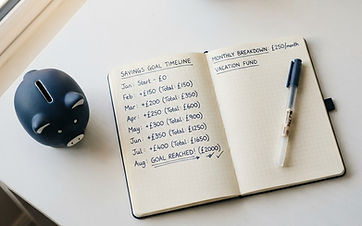
Once the money is separated, make the progress visible. A goal you can see is a goal you stick with.
- Track the balance. Check the savings account regularly — watching the number grow is motivating.
- Use a visual. A simple progress bar or a chart showing how far you've come and how far is left.
- Celebrate milestones. When you hit 25%, 50%, 75%, acknowledge it. Not with a purchase — with a moment of recognition.
The Payday Compass app shows each goal as a card with a progress bar, current amount, target amount, and the contribution needed per pay to stay on track. You can see all your goals at a glance and know exactly where each one stands.
Step 6: Handle setbacks without giving up
Every savings journey has setbacks — an unexpected bill, a month of higher spending, a temptation to spend the savings. The mistake is treating a setback as a failure and abandoning the goal.
Instead:
- Expect setbacks. They're normal, not a sign you can't save.
- Recalculate, don't restart. If you miss a contribution, adjust the timeline or the per-pay amount. The goal isn't dead — it just takes a little longer.
- Don't touch the principal. If you need to dip into savings for an emergency, treat it as a loan to yourself and plan to replace it.
Step 7: Connect the goal to your cash flow
The most overlooked part of savings goals is checking whether your cash flow actually supports the per-pay contribution. You might decide to save $135 per fortnight, but if your available money after bills is only $100, the goal will fail by the second pay.
Before you commit, use the free payday calculator to see your available money and daily allowance. If the contribution fits comfortably within your available money, the goal is sustainable. If it's tight, reduce the amount or extend the deadline rather than setting yourself up to fail.
Common savings goal mistakes
- Setting the bar too high. A goal that requires you to save 40% of your pay is probably unsustainable. Aim for 10–20% to start.
- No deadline. A goal without a deadline is a wish. The deadline creates urgency and makes the per-pay calculation possible.
- Saving what's left. If you wait to see what's left at the end of the pay, there's usually nothing. Save first, spend what's left.
- One big account. If your savings, emergency fund, and goal money are all in one account, you can't tell what's what. Separate them.
Summary
A savings goal you'll actually reach has five things: one focus, a specific amount and deadline, a per-pay contribution that fits your cash flow, a separate account, and visible progress. The system is simple — the discipline is in setting it up and letting it run. Once the automatic transfer is in place, the goal achieves itself one pay at a time.
To set up and track savings goals with progress bars and per-pay contributions, try the Payday Compass Goal Navigator.
Put it into practice
The Payday Compass workbook brings these ideas together in one organised spreadsheet.
Explore the Budget Planner