How to Calculate How Long It Will Take to Reach Your Savings Goal
How long will it take to reach your savings goal? The calculation is simple: divide the target by the per-pay amount. Learn the maths, the per-pay version, and what to adjust when the timeline doesn't work.
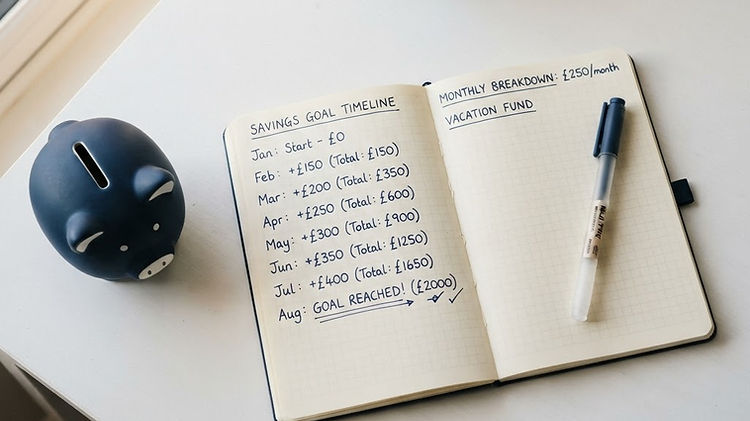
The savings timeline calculation
One of the most common savings questions is simple: "How long will it take?" You have a target amount, you can save a certain amount per pay, and you want to know the date you'll reach it.
The calculation is straightforward. The value is in doing it before you start, so you know whether your goal is realistic — and if it's not, what to adjust.
The basic calculation
Months to target = Total target ÷ Monthly savings
For example, saving $2,000/month toward $10,000:
$10,000 ÷ $2,000 = 5 months
This is the simplest version. It assumes you're saving a fixed amount every month and not earning interest. For short-term goals (under 2 years), this is usually good enough — the interest is small and the calculation is easy to adjust.
Adding interest
If you're saving in a high-interest account, your money earns interest as it grows. This shortens the timeline slightly:
- Estimate the average balance. Over the saving period, your balance goes from $0 to the target. The average is roughly half the target.
- Calculate interest on the average. Average balance × interest rate × time.
- Subtract the interest from the target. This gives you the amount you actually need to save.
For example, saving $10,000 at 5% interest over 10 months:
- Average balance: ~$5,000
- Interest: $5,000 × 5% × (10/12) = ~$208
- Amount to save: $10,000 − $208 = $9,792
- Months to save $9,792 at $2,000/month: ~4.9 months (vs 5 without interest)
For most practical purposes, the interest on a 1–2 year savings goal is small enough to ignore. If your timeline is longer (3+ years), the interest matters more and you should include it.
The per-pay version
Most people save per pay, not per month. To calculate in pays:
Pays to target = Total target ÷ Per-pay savings
For example, saving $135 per fortnight toward $3,500:
$3,500 ÷ $135 = 26 fortnights (about 12 months)
Then convert pays to months:
- Fortnightly pays: pays ÷ 2.17 = months
- Weekly pays: pays ÷ 4.33 = months
26 fortnights ÷ 2.17 = 12 months
Working backwards: how much to save per pay
If you have a fixed deadline, the calculation reverses:
Per-pay savings = Total target ÷ Number of pays until deadline
For example, $3,500 by October next year (26 fortnights away):
$3,500 ÷ 26 = $135 per fortnight
This is the more useful calculation for most people, because the deadline is often fixed (a trip, a wedding, a car rego) and the question is how much to save each pay.
Example: Three common goals
A $3,500 holiday in 12 months
- Pays: 26 fortnights
- Per pay: $3,500 ÷ 26 = $135/fortnight
- Check: does $135/fortnight fit your available money? Use the free payday calculator to see.
A $50,000 house deposit in 3 years
- Pays: 78 fortnights
- Per pay: $50,000 ÷ 78 = $641/fortnight
- Check: this is about $1,393/month. If your available money after bills is $2,000/month, it's achievable but tight.
A $1,000 emergency fund in 4 months
- Pays: ~9 fortnights
- Per pay: $1,000 ÷ 9 = $111/fortnight
- Check: most people can find $111/fortnight by reducing discretionary spending.
When the timeline doesn't work
If the calculation shows a timeline that's too long or a per-pay amount that's too high, you have three levers:
1. Adjust the amount
Can you achieve the same goal for less? A cheaper holiday, a smaller deposit (10% instead of 20%), a used car instead of new. Reducing the target is often the fastest way to make a goal achievable.
2. Adjust the deadline
Can you wait longer? A 2-year goal instead of 1 year halves the per-pay amount. This isn't always possible (a bill has a fixed due date), but for flexible goals it's the easiest lever.
3. Adjust your savings rate
Can you save more? This means earning more or spending less. It's the hardest lever but the most powerful, because it affects every future goal, not just this one.
Tracking progress
Once you've started, track your progress to stay motivated and on course:
- Check the balance regularly. Watching the number grow is motivating.
- Compare actual to planned. Are you ahead or behind? If behind, adjust.
- Recalculate after setbacks. If you miss a contribution, the timeline extends. Recalculate and adjust rather than abandoning the goal.
The Payday Compass Goal Navigator does this automatically — you enter the target amount, deadline, and current balance, and it calculates the per-pay contribution needed to stay on track and shows your progress as a percentage.
Summary
The savings timeline calculation is simple: divide the target by the per-pay amount to get the number of pays, or divide by the number of pays to get the per-pay amount. The value isn't in the maths — it's in doing the calculation before you start, so you know whether the goal is realistic and what to adjust if it isn't. Use the calculation to set the per-pay amount, automate the transfer, and track your progress.
To calculate and track savings goals automatically, try the Payday Compass Goal Navigator.
Put it into practice
The Payday Compass workbook brings these ideas together in one organised spreadsheet.
Explore the Budget Planner


