How to Organise and Pay Off Your Debt: A Complete Guide
Debt is a leak in the bucket — no matter how much you earn, it drains out. Learn the complete system: list every debt, choose a payoff strategy, find extra money, reduce interest rates, and stop the cycle.
Why debt organisation comes first
Debt is the financial equivalent of a leak in a bucket. No matter how much water you pour in, the bucket never fills — because it's draining out the bottom. Before you can build savings, reach savings goals, or get ahead, you need to plug the leak.
This is why debt organisation comes first. It's not the most exciting financial task, but it's the one that makes everything else possible. A household carrying $15,000 in credit card debt at 20% interest is paying $3,000/year in interest alone — money that could be going toward a house deposit, a holiday, or retirement.
This guide walks through a complete system for organising and paying off debt.
Step 1: Face the full picture
The first step is the hardest: facing the full picture. Many people know they have debt but avoid the details because it's uncomfortable. But you can't organise what you don't acknowledge.
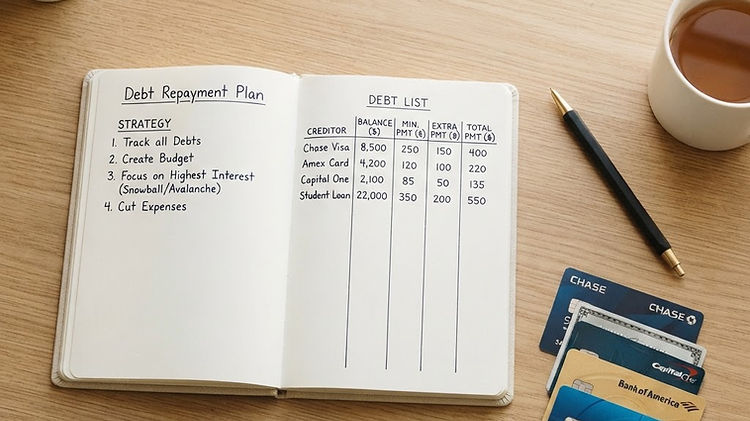
List every debt
Write down every debt you have, no exceptions:
| Debt | Balance | Interest rate | Minimum payment | |---|---|---|---| | Credit card (ANZ) | $4,200 | 19.99% | $85 | | Credit card (CommBank) | $2,800 | 20.99% | $56 | | Personal loan | $8,000 | 12.99% | $180 | | Buy now pay later (Afterpay) | $600 | 0% (if paid on time) | $150 | | HECS-HELP | $24,000 | CPI indexation | $0 (income-contingent) | | Car loan | $12,000 | 8.99% | $310 | | Total | $51,600 | | $781 |
For each debt, note:
- The current balance — check your latest statement or app
- The interest rate — this determines the cost of carrying the debt
- The minimum payment — what you must pay to avoid default
- The type — revolving (credit cards), fixed-term (personal loans, car loans), or income-contingent (HECS)
Don't forget less obvious debts
- Buy now pay later (Afterpay, Zip, humm) — these are debt even if they're interest-free
- Family loans — money borrowed from family that you intend to repay
- Tax debt — owed to the ATO
- Outstanding bills — overdue utilities, medical bills
Step 2: Understand the cost
Once you have the list, understand what each debt is costing you. The interest rate tells you the priority — higher rates cost more and should be paid off first.
The true cost of minimum payments
Credit card minimum payments are designed to keep you in debt. If you have a $4,200 balance at 20% and pay only the minimum ($85/month), it takes roughly 7 years to pay off and costs about $3,500 in interest — nearly as much as the original debt.
If you pay $200/month instead, the same debt is gone in 2 years and costs about $850 in interest. The difference between minimum payments and a real repayment plan is thousands of dollars and years of your life.
HECS-HELP is different
HECS-HELP is income-contingent — you only repay it when your income exceeds a threshold, and the repayment is a percentage of your income. The interest is CPI indexation, which is lower than most commercial debt. For most people, HECS should be paid off through the automatic system, not through voluntary extra repayments — the money is better used to pay off commercial debt or build savings first.
Step 3: Choose a payoff strategy
Two strategies dominate debt payoff, and the best one depends on your personality:
The avalanche method (mathematically optimal)
Pay minimums on all debts, then put every extra dollar toward the highest interest rate debt first. Once it's paid off, move to the next highest.
Order: 20.99% card → 19.99% card → 12.99% loan → 8.99% car loan
Pros: Saves the most money in interest. Gets you debt-free fastest in total dollars. Cons: The highest-rate debt might have the largest balance, so it takes a long time to see progress. Some people lose motivation.
The snowball method (psychologically optimal)
Pay minimums on all debts, then put every extra dollar toward the smallest balance first, regardless of interest rate. Once it's paid off, move to the next smallest.
Order: $600 Afterpay → $2,800 card → $4,200 card → $8,000 loan → $12,000 car loan
Pros: Quick wins build motivation. You see debts disappear fast. Cons: Costs slightly more in interest than the avalanche method.
Which to choose?
- Choose avalanche if you're motivated by numbers and can stick with a long-term plan without visible progress.
- Choose snowball if you've tried to pay off debt before and given up, or if you need the motivation of quick wins to stay on track.
The best strategy is the one you'll actually follow. A mathematically optimal plan you abandon is worse than a slightly suboptimal plan you complete.
Step 4: Find extra money for debt
The strategy only works if you have money beyond the minimum payments to put toward debt. Two sources:
Reduce spending
- Audit your bills. Review subscriptions, insurance, phone plans. See our guide to auditing subscriptions.
- Cut discretionary spending. Dining out, entertainment, non-essential shopping. This is temporary — once the debt is gone, you can relax.
- Use the free payday calculator. Enter your income and bills to see your available money and daily allowance. Everything above your needs can go to debt.
Increase income
- Side income. Freelancing, casual work, selling unwanted items.
- Tax return. If you receive a tax refund, put it all toward debt.
- Bonuses and overtime. Any irregular income goes to debt, not lifestyle.
The debt payment amount
Decide on a total monthly debt payment — the sum of all minimums plus whatever extra you can find. For example:
- Minimums: $781/month
- Extra from spending cuts: $200/month
- Extra from side income: $150/month
- Total debt payment: $1,131/month
This is your debt payment budget. Every month, you pay $1,131 toward debt, distributed according to your chosen strategy.
Step 5: Reduce the interest rate
Lowering the interest rate on your debt means more of your payment goes to principal, shortening the timeline and reducing the total cost.
Balance transfers
Many credit cards offer 0% or low-interest balance transfer periods (12–24 months). Transferring a 20% balance to a 0% card means every dollar you pay reduces the principal.
Rules:
- Pay off the balance before the promotional period ends — the rate reverts to 20%+ after.
- Don't use the new card for purchases — the 0% rate usually applies only to the transferred balance.
- Be aware of balance transfer fees (typically 1–2% of the transferred amount).
Debt consolidation loans
A personal loan at 10–12% can consolidate multiple credit card debts at 20%+. You get one payment, a lower rate, and a fixed payoff timeline.
Rules:
- Only consolidate if the new rate is lower than your current rates.
- Don't consolidate and then run up the credit cards again — this leaves you with more debt, not less.
- Check the fees — some consolidation loans have establishment fees that reduce the benefit.
Negotiate with lenders
- Credit card providers. Call and ask for a lower rate. Some will reduce it, especially if you mention you're considering a balance transfer.
- Personal loan providers. Ask about hardship provisions or rate reductions if you're struggling.
- Utility and telco providers. If you have overdue bills, ask about payment plans — many offer interest-free instalment plans.
Step 6: Stop accumulating new debt
Paying off debt while accumulating new debt is running on a treadmill. You have to stop the cycle.
- Remove credit cards from your wallet and phone. Use a debit card for everyday spending.
- Don't use buy now pay later for purchases you can't afford. BNPL is debt, even if it's interest-free.
- Build a small emergency fund first. $500–$1,000 is enough to cover minor surprises so you don't reach for a credit card when the car needs a service.
- Wait 48 hours before non-essential purchases. Most impulse desires fade in two days.
Step 7: Track and celebrate
Debt payoff is a marathon. Stay on track by:
- Tracking the total balance. Watch it go down every month. The number shrinking is motivating.
- Celebrating milestones. Every $5,000 paid off is a milestone. Acknowledge it.
- Recalculating after each debt is paid off. When one debt is gone, redirect its payment to the next one — don't absorb it into spending.
The Payday Compass app lets you track your debts alongside your income and bills, so you can see your total debt, your payoff progress, and how your debt payments affect your runway.
Summary
Debt organisation is the foundation of financial progress. List every debt, understand the cost, choose a payoff strategy (avalanche for maths, snowball for motivation), find extra money by reducing spending and increasing income, reduce interest rates with balance transfers or consolidation, stop accumulating new debt, and track your progress. The key is consistency — a monthly debt payment that you make every month, directed at your highest-priority debt, will get you debt-free faster than you think.
To track your debt payoff alongside your full financial picture, try the Payday Compass Money Runway. For a quick check on how much you can put toward debt, use the free payday calculator.
Put it into practice
The Payday Compass workbook brings these ideas together in one organised spreadsheet.
Explore the Budget Planner