Debt Avalanche vs Debt Snowball: Which Should You Choose?
The avalanche method saves the most money by targeting the highest interest rate. The snowball method builds motivation by targeting the smallest balance. Learn how each works and which to choose.

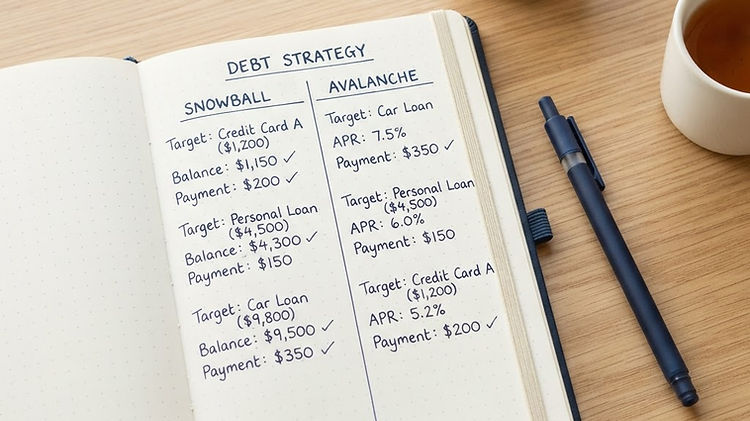
The two strategies
When you have multiple debts, you need a system for which to pay off first. Two strategies dominate personal finance, and they differ in one key way: one is mathematically optimal, the other is psychologically powerful.
- The avalanche method — pay off the debt with the highest interest rate first
- The snowball method — pay off the debt with the smallest balance first
Both work. Both will get you debt-free. The question is which one will keep you going when the motivation fades.
How the avalanche method works
The avalanche method targets the most expensive debt first. You pay the minimum on every debt, then put every extra dollar toward the debt with the highest interest rate. Once that debt is gone, you move to the next highest rate.
Example
| Debt | Balance | Rate | Minimum | |---|---|---|---| | Credit card A | $4,200 | 20.99% | $84 | | Credit card B | $2,800 | 19.99% | $56 | | Personal loan | $8,000 | 12.99% | $180 | | Car loan | $12,000 | 8.99% | $310 |
Avalanche order: Credit card A (20.99%) → Credit card B (19.99%) → Personal loan (12.99%) → Car loan (8.99%)
You pay $84 + $56 + $180 + $310 = $630 in minimums, plus let's say $300 extra. The $300 goes to Credit card A. Once Card A is paid off, the $384 ($84 minimum + $300 extra) goes to Card B. And so on.
Why it's mathematically optimal
The avalanche method saves the most interest because you're eliminating the most expensive debt first. Every dollar you direct to a 20.99% debt saves you 20.99 cents per year; the same dollar directed to an 8.99% debt saves only 8.99 cents. Over the full payoff, the difference can be hundreds or thousands of dollars.
The downside
The highest-rate debt might also have the largest balance. If your highest-rate debt is a $15,000 personal loan, it might take 18 months to pay off — and during that time, you see no debts disappear. For some people, this lack of visible progress is demoralising, and they give up.
How the snowball method works
The snowball method targets the smallest balance first, regardless of interest rate. You pay the minimum on every debt, then put every extra dollar toward the debt with the smallest balance. Once it's gone, you move to the next smallest.
Example (same debts)
Snowball order: Credit card B ($2,800) → Credit card A ($4,200) → Personal loan ($8,000) → Car loan ($12,000)
You pay all minimums ($630) plus $300 extra to Credit card B. Once Card B is gone, the $356 ($56 + $300) goes to Card A. And so on.
Why it's psychologically powerful
The snowball method gives you quick wins. Credit card B ($2,800) might be gone in 6–9 months. Seeing a debt eliminated is deeply motivating — it proves the plan is working and builds momentum. Each debt you pay off frees up its minimum payment, which you redirect to the next debt, creating a "snowball" of increasing payments.
The downside
The snowball method costs more in interest than the avalanche method because you might pay off a low-rate debt before a high-rate one. In the example, you pay off Card B (19.99%) before Card A (20.99%) — the opposite of what the maths suggests.
The numbers: how much difference does it make?
Using the example debts and a $300/month extra payment, let's compare:
Avalanche (highest rate first)
- Pay off Card A (20.99%, $4,200) — about 14 months
- Pay off Card B (19.99%, $2,800) — about 6 more months
- Pay off personal loan (12.99%, $8,000) — about 14 more months
- Pay off car loan (8.99%, $12,000) — about 20 more months
Total: about 54 months, roughly $5,200 in interest
Snowball (smallest balance first)
- Pay off Card B ($2,800) — about 9 months
- Pay off Card A ($4,200) — about 11 more months
- Pay off personal loan ($8,000) — about 14 more months
- Pay off car loan ($12,000) — about 20 more months
Total: about 54 months, roughly $5,400 in interest
The difference is about $200 in interest over 4.5 years — small in the grand scheme, because the two credit cards have similar rates and balances. The difference grows when your debts have more varied rates and balances.
When the difference is larger
If you have a $15,000 debt at 5% (say, a car loan) and a $3,000 credit card at 20%, the snowball method pays off the $3,000 card first (good — high rate and small balance). But if you have a $15,000 credit card at 20% and a $3,000 personal loan at 8%, the snowball pays off the $3,000 loan first — costing you years of 20% interest on the $15,000 card. In this case, the avalanche saves significantly more.
Which should you choose?
Choose the avalanche if:
- You're motivated by numbers and optimisation
- You can stick with a plan without needing visible wins
- Your debts have significantly different interest rates
- You have large high-rate debts that are costing you a lot
Choose the snowball if:
- You've tried to pay off debt before and given up
- You need motivation to stay on track
- Your debts have similar interest rates (so the cost difference is small)
- You have several small debts that would be quick wins
A hybrid approach
You don't have to follow one purely. A common hybrid: pay off one or two small debts first (for motivation), then switch to the avalanche for the rest. This gives you a quick win and then optimises the remaining payoff.
The step that matters more than the strategy
Both strategies share one critical step: paying more than the minimum. The strategy determines which debt gets the extra money, but the amount of extra money determines how fast you get debt-free.
- Minimum payments only: 7+ years, maximum interest
- $200/month extra: 3–4 years, moderate interest
- $500/month extra: 1.5–2 years, low interest
The difference between $0 extra and $500 extra is far larger than the difference between avalanche and snowball. Focus first on finding as much extra money as you can — by reducing spending, increasing income, or both — and then use the strategy to direct it.
Use the free payday calculator to see how much extra you can put toward debt after your bills and living costs.
How to set it up
- List all your debts with balance, rate, and minimum. See our guide to organising your debt.
- Choose your strategy — avalanche or snowball (or hybrid).
- Calculate your total monthly debt payment — all minimums plus your extra amount.
- Automate the minimums so you never miss a payment.
- Direct the extra amount to your target debt each month.
- When a debt is paid off, redirect its payment to the next debt in your order. Don't absorb it into spending.
- Track the total debt balance — watch it shrink every month.
The Payday Compass app lets you track all your debts alongside your income and bills, so you can see your total debt, your payoff progress, and how your debt payments fit within your overall money runway.
Summary
The avalanche method saves the most money by targeting the highest interest rate first. The snowball method builds the most motivation by targeting the smallest balance first. The difference in total interest is often small, especially when your debts have similar rates. The factor that matters far more than which strategy you choose is how much extra you pay each month — the more, the faster you're debt-free. Choose the strategy that will keep you going, find as much extra money as you can, and automate the process.
To track your debt payoff alongside your full financial picture, try the Payday Compass Money Runway.
Put it into practice
The Payday Compass workbook brings these ideas together in one organised spreadsheet.
Explore the Budget Planner