Will My Money Last Until Next Payday? How to Check Your Runway
Not sure whether your balance will hold until your next payday? Learn how to check your money runway, project your balance between pays, and spot the dates where funds might run low before it happens.
The question every pay cycle asks
"Will my money last until next payday?" is the question that sits behind almost every budgeting decision. It's the reason you hesitate before a purchase, the reason you check your account balance mid-cycle, and the reason an unexpected bill feels like a crisis.
Most people answer it by feel — a rough sense of whether there's "enough" in the account. That works until it doesn't, usually the week a bill you forgot about lands on the same day as a larger-than-usual grocery shop. A better answer exists, and it doesn't require linking your bank or importing transactions. It comes from understanding your money runway.
This guide explains what a money runway is, how to calculate yours, and how to use it to make confident decisions between paydays.
What is a money runway?
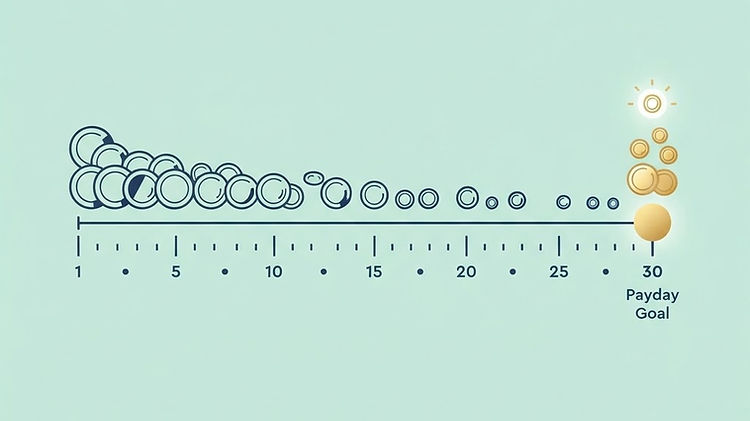
Your money runway is how long your current balance (plus any income due before the next payday) will cover your scheduled expenses before the balance hits zero or your minimum buffer. Think of it the way a business thinks about cash runway: given what's in the bank and what's committed, how many days can you keep going?
The runway has two parts:
- Starting balance: what's in your account right now
- Scheduled money in and out: income due before the next payday, and bills and commitments due before the next payday
The runway ends when your projected balance falls to your minimum buffer (the lowest you're willing to let the account go) or to zero. The date that happens is your runway date.
Why the runway matters more than the balance
A balance of $500 means very different things depending on what's due. If nothing is due before payday, $500 is comfortable. If a $480 phone bill is due tomorrow, $500 is a $20 margin. The balance alone doesn't tell you whether you're safe; the runway does, because it folds in what's coming.
This is why checking your balance and checking your runway are different habits. The balance tells you where you are. The runway tells you where you're going.
<!--RUNWAY-CHART-->How to check your runway manually
You don't need an app to check your runway. A pen, a notebook, and ten minutes the night before payday will do. Here's the manual method.
Step 1: Write down your starting balance
Use the cleared balance in your everyday account, not the available balance (which may include pending transactions that haven't settled). If you keep a separate bills account, include that too.
Step 2: List income due before the next payday
Include only income you're confident will arrive. Mark each one with its expected date and amount:
| Income | Date | Amount | |---|---|---| | Salary | Fri 24 Oct | $1,820 | | Side gig | Tue 21 Oct | $240 | | Total in | | $2,060 |
If income is irregular, only count what's confirmed. Expected but unconfirmed income should be treated as a maybe, not a fact. See our guide to budgeting on a fortnightly pay cycle in Australia for handling variable income.
Step 3: List bills and commitments due before the next payday
Go through every regular bill, subscription, and debt payment. Include the ones that fall due in this cycle only:
| Bill | Due date | Amount | |---|---|---| | Rent | Fri 17 Oct | $1,200 | | Phone | Mon 20 Oct | $90 | | Electricity (monthly estimate) | Wed 22 Oct | $180 | | Groceries (weekly) | Sat 18 Oct | $160 | | Fuel | Sun 19 Oct | $70 | | Total out | | $1,700 |
Don't forget the irregular costs — car registration, insurance, rates — that don't hit every cycle. These are the ones that catch people out. A sinking fund is the usual answer: you set aside a little each pay so the bill doesn't land as a lump sum.
Step 4: Project the balance day by day
Starting from your opening balance, add income on its date and subtract bills on theirs. The running total is your projected balance:
| Date | In | Out | Balance | |---|---|---|---| | Opening (Wed 15 Oct) | | | $640 | | Fri 17 Oct | | $1,200 | -$560 | | Sat 18 Oct | | $160 | -$720 | | Sun 19 Oct | | $70 | -$790 | | Mon 20 Oct | | $90 | -$880 | | Tue 21 Oct | $240 | | -$640 | | Wed 22 Oct | | $180 | -$820 | | Fri 24 Oct | $1,820 | | $1,000 |
In this example, the balance goes negative on the 17th and stays negative until payday on the 24th. That's a runway breach — the money does not last until next payday. The runway date is the 17th, the day the balance first crosses below the buffer.
Step 5: Find your runway date and your gap
Your runway date is the first day the projected balance falls below your minimum buffer. Your gap is how much you're short by, and for how long.
In the example above:
- Runway date: Fri 17 Oct (rent day)
- Gap at worst point: -$880 (on Wed 22 Oct)
- Days below buffer: 7 days
Once you know the gap, you know what you're solving for. A $880 gap for 7 days is a different problem to a $50 gap for one day.
<!--RUNWAY-CHECKER-->What a healthy runway looks like
A healthy runway has the projected balance staying above your minimum buffer for the entire cycle, with a little room to spare. The room to spare is your buffer — the cushion that absorbs the things you can't predict.
Setting a minimum buffer
A minimum buffer is the lowest you're willing to let your everyday account go. It's not your savings; it's the floor of your operating account. Common approaches:
- A flat amount: e.g., $200. Simple, but doesn't scale with your spending.
- A week of expenses: e.g., if you spend $700/week, your buffer is $700. Scales with your life.
- A percentage of one pay: e.g., 10% of a $1,820 pay is $182. Tied to your income.
Pick one and stick to it. The buffer is what tells you whether a projected balance is "fine" or "tight" — without it, every number feels like a guess.
The three runway shapes
When you project your balance across a cycle, the line usually takes one of three shapes:
- Comfortable: the balance stays above the buffer the whole cycle. You have room for discretionary spending and small surprises.
- Tight: the balance dips close to the buffer but doesn't breach. There's little room for surprises; a single unexpected bill could push you under.
- Breached: the balance goes below the buffer (or negative) at some point. You need to act before that date — reduce spending, shift a bill, or use savings.
Knowing which shape you're in tells you what to do next. Comfortable means keep going. Tight means slow down on discretionary spending. Breached means act now.
What to do when your runway is breached
A breached runway is not a moral failing; it's information. It tells you that, on the current plan, the money won't last. Here's how to respond.
Option 1: Reduce spending in the cycle
The fastest fix is to cut discretionary spending between now and the breach date. If the breach is on the 17th and today is the 15th, you have two days to pull back. Groceries, eating out, and non-essential shopping are the usual levers. Use the free payday calculator to see the impact of a lower spend figure.
Option 2: Shift a bill
Some bills can be moved without penalty. A credit card payment, a subscription, or a voluntary extra debt repayment can often be delayed a few days. Call the provider if it's a utility — many will shift a due date if you ask before it's due.
Option 3: Use savings, deliberately
If you have an emergency fund or a sinking fund, you can transfer from it to cover the gap — but do it deliberately, not by accident. Record it as a transfer, not as spending, so your plan stays honest. Replenish the fund over the next one or two pays.
Option 4: Change the cycle
If the same bill breaches your runway every cycle, the cycle itself needs to change. Options:
- Split the bill: ask for fortnightly or monthly instalments instead of a quarterly lump sum.
- Move the due date: many providers will align a due date with your payday.
- Build a sinking fund: save a little each pay so the bill is already funded when it arrives.
See our guide to managing household bills for the full system.
Tools that project your runway for you
The manual method works, but it's repetitive. If you want to check your runway every pay — which is the point — a tool that does the arithmetic for you makes it a habit instead of a chore.
What a runway planner does
A runway planner takes the same inputs you'd write down — balance, payday schedule, bills, income — and projects the balance automatically. The better ones:
- Show the projected balance as a line, so you can see the shape (comfortable, tight, breached) at a glance.
- Flag breach dates before they arrive, not after.
- Let you test a decision — a purchase, an extra bill, a pay change — and see the impact on the runway before you commit.
- Work without bank linking, so your figures stay private and you stay in control of what's entered.
This is what the Money Runway module in Payday Compass does: you enter your balance, payday, bills and income once, and it projects the balance across the cycle, marks the breach dates, and lets you test decisions against the runway.
Manual entry vs bank-connected tools
Some budgeting tools link to your bank and import transactions automatically. That's convenient, but it comes with trade-offs:
- Privacy: your transaction data leaves your bank and sits in a third-party system.
- Control: the tool categorises transactions for you, and its guesses aren't always right.
- Honesty: automatic import records what you spent, not what you planned to spend. A runway is about the plan.
Manual entry tools — a spreadsheet, a workbook, or an app like Payday Compass — put you in control of the inputs. You enter what you know is coming, and the tool projects from there. The trade-off is the few minutes of entry each pay. For most people, that's the point: the act of entering your figures is what keeps you aware of them. See our guide to manual entry vs bank-connected budgeting apps for a fuller comparison.
A weekly habit: the runway check
The runway is most useful when you check it regularly, not just when you're worried. A simple weekly habit:
- The night before payday: enter your expected income and the bills due this cycle. Note the runway shape.
- Mid-cycle (e.g., Sunday evening): update actual spending against the plan. Has the runway changed? Is a breach appearing?
- Before any large purchase: test the purchase against the runway. If it breaches the buffer, either delay it or reduce something else.
This is the rhythm the Money Brief module automates: a weekly summary of what's due, what's left, and what to do next, based on your runway.
Common runway mistakes
- Using the available balance, not the cleared balance. Pending transactions can make the available balance look lower (or higher) than reality. Use the cleared balance for projections.
- Forgetting irregular bills. The bills that don't come every pay are the ones that breach the runway. List them all, even if they're not due this cycle.
- Counting uncertain income as confirmed. A bonus, a tax refund, a side gig that might pay — treat these as maybes, not as income, until they're in the account.
- No buffer. Without a minimum buffer, every projected balance feels "probably fine". Pick a number and let it do the judging.
- Checking once and forgetting. The runway changes as bills move and spending happens. A runway you checked in week one is stale by week two.
The takeaway
"Will my money last until next payday?" stops being a feeling and starts being a number when you check your runway. The number tells you whether you're comfortable, tight, or breached, and — if you're breached — how big the gap is and when it arrives. From there, the decisions are straightforward: reduce spending, shift a bill, use savings, or change the cycle.
You can do this with a notebook and ten minutes. If you want the arithmetic done for you, a runway planner — manual entry, no bank linking — turns it into a weekly habit. Either way, the point is the same: know what's coming, and the worry between paydays gets a lot quieter.
Payday Compass is an organisational tool, not personal financial advice. Projections are estimates based on information you enter and cannot guarantee future balances.
Put it into practice
The Payday Compass workbook brings these ideas together in one organised spreadsheet.
Explore the Budget Planner