Fortnightly Budget: How to Budget on a Fortnightly Pay Cycle
Fortnightly pay is the most common cycle in Australia, but most budgeting advice is written for monthly income. Learn how to handle monthly bills, three-pay months and keep spending steady across both weeks.
Why fortnightly budgeting is different
A monthly budget assumes 12 income events and 12 expense periods. A fortnightly budget has 26 income events and roughly 2.17 expense periods per month. The mismatch creates two common problems:
- Monthly bills don't align. Your rent is due on the 1st, but your payday might be the 7th and the 21st. Some cycles the rent comes out of the first pay; some cycles it comes out of the second.
- Three-pay months happen. Twice a year, a month has three pays instead of two. If you spend all three, you're fine — but if you'd planned to save from the "extra" pay, you need to know when it's coming.
Step 1: Map your paydays
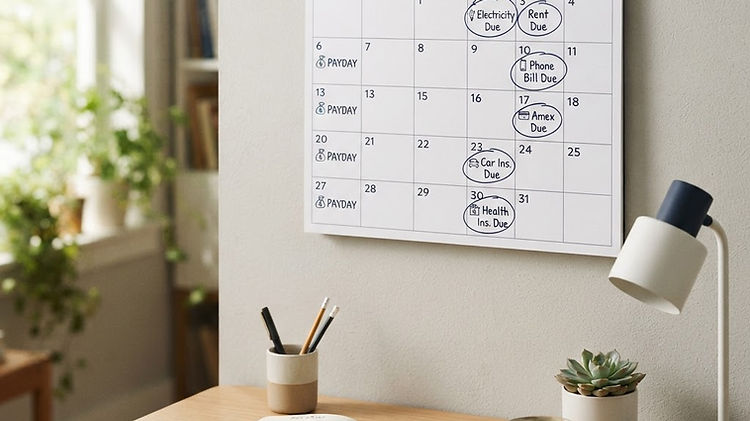
Start by listing your next 6–12 paydays on a calendar. This sounds tedious, but it takes two minutes and it's the foundation everything else builds on.
Once you can see your paydays, mark which bills fall due in each cycle. You'll quickly see whether your bills cluster in one pay or are spread across both — and that tells you whether you need to hold money back from the first pay to cover the second.
Step 2: Handle monthly bills on a fortnightly cycle
Monthly bills (rent, mortgage, phone, subscriptions) don't change their date just because your pay cycle is different. The cleanest approach is to split each monthly bill across both pays:
- Rent of $2,000/month → $1,000 from each pay
- Phone of $80/month → $40 from each pay
- Streaming of $25/month → $12.50 from each pay
You can do this by moving the money to a bills account on payday, or by tracking it in a spreadsheet. The point is that when the bill arrives, the full amount is already set aside — you're not scrambling to find it from a single pay.
Step 3: Plan for three-pay months
Twice a year, you'll have a month with three pays instead of two. These are the best opportunities in a fortnightly cycle — but only if you plan for them.
Decide in advance what the third pay is for:
- Savings or sinking funds — top up your emergency fund, annual bills account, or holiday fund
- Debt — make an extra repayment on a loan or credit card
- A specific goal — a purchase you've been delaying, a trip, a course
If you don't decide in advance, the third pay disappears into general spending and you wonder where it went. Mark your three-pay months on the calendar so you see them coming.
Step 4: Set a per-pay spending amount
After bills and savings are allocated, what's left is your spending money for the fortnight — groceries, petrol, entertainment, personal spending.
Divide it by 14 to get a daily amount, or by 2 to get a weekly amount. Use whichever you find easier to stick to. The number is a ceiling, not a target — some days you'll spend more, some less, and the average holds.
If you're not sure where to start, use the free payday calculator to see your available money and daily allowance for the current cycle.
Step 5: Build a buffer that smooths the gaps
A buffer is especially important on a fortnightly cycle because the gap between pays is shorter — 14 days instead of 30. If you run out on day 10, you only have 4 days to cover, but if a bill hits on day 12 that you forgot about, there's no next pay to save you.
Start with a buffer of $100–$300 and build it up over a few cycles. Once your buffer is stable, you can use it to smooth the gap between pays — spend from the first pay, hold the buffer, and top it up from the second.
Common fortnightly budgeting mistakes
- Treating each pay as separate. If you spend freely from the first pay because "the next one is soon," you'll consistently run short in the second week.
- Forgetting the half-monthly bills. Bills that come out mid-cycle (on the 15th, for example) can land in either pay depending on the fortnight. Track which pay they fall in.
- Not adjusting when payday shifts. Public holidays can move your payday by a day or two. If you've timed bills to the exact date, a shift can cause a missed payment or a late fee.
- Spending the third pay. It feels like a bonus, but if you haven't planned for it, it vanishes.
Tools that help
A spreadsheet works, but it needs to be maintained. The Payday Compass app handles fortnightly cycles natively — it projects your balance across pay cycles, flags tight spots, and lets you model decisions before you make them.
For a quick check on where you stand right now, the free payday calculator gives you your available money and daily allowance in under a minute.
Summary
Fortnightly budgeting isn't harder than monthly budgeting — it's just different. The keys are: map your paydays, split monthly bills across both pays, plan for three-pay months, and keep a buffer that smooths the gap. Once the rhythm is set, a fortnightly cycle is one of the easiest to manage — you never go more than two weeks between pays, and the cycles are short enough to course-correct quickly.
Put it into practice
The Payday Compass workbook brings these ideas together in one organised spreadsheet.
Explore the Budget Planner