How to Budget for a Trip in a Foreign Currency
Budgeting for a trip in a foreign currency adds a layer of complexity. Learn how to plan the total cost, convert to the trip currency, build a travel sinking fund, track spending, and manage exchange rate risk.

The challenge of multi-currency budgeting
Budgeting for a trip in a foreign currency adds a layer of complexity that domestic budgeting doesn't have. You're not just planning what to spend — you're planning what to spend in a currency you don't think in, with exchange rates that change, and fees that can quietly eat into your budget.
This guide covers how to budget for a trip in a foreign currency, from planning the total cost to managing money while you're away.
Step 1: Choose your planning currency
The first decision is whether to plan in your home currency (AUD) or the trip currency (e.g., JPY, EUR, USD). Both approaches work, but they have different trade-offs:
Planning in AUD
You set a total budget in Australian dollars and convert it to the trip currency when you spend.
Pros: Easy to compare to your normal budget. You know what $3,000 AUD means to you. Cons: The actual spending happens in the trip currency, so you're always converting. Exchange rate changes affect how much you can spend.
Planning in the trip currency
You set a total budget in the trip currency (e.g., 250,000 JPY) and track spending in that currency.
Pros: You budget and spend in the same currency — no conversion needed during the trip. Local prices make sense immediately. Cons: Harder to compare to your normal budget. You need to convert to AUD to know how much you're really spending.
The recommendation
Plan the total in AUD, but track daily spending in the trip currency. This gives you the best of both: you know what the trip costs you in real terms, but you can spend naturally while you're there without constantly converting.
Step 2: Research the total cost
Before you can budget, you need to know what the trip costs. Research each category:
Flights
- Return flights: the largest single cost. Use comparison sites like Skyscanner or Google Flights.
- Internal flights or trains: for travel within the country or region.
Accommodation
- Hotels, hostels, Airbnb: research the typical cost per night in each city you'll visit.
- Total accommodation cost: cost per night × number of nights.
Food
- Daily food budget: research the cost of a typical meal in your destination. A bowl of ramen in Tokyo costs about 1,000 JPY ($10 AUD); a restaurant meal in Paris costs about 20 EUR ($33 AUD).
- Total food cost: daily food budget × number of days.
Transport
- Airport transfers: to and from the airport at each end.
- Local transport: public transport, taxis, car hire. Research the typical daily cost.
Activities
- Entry fees: museums, temples, attractions, tours.
- Experiences: cooking classes, guided tours, adventure activities.
Other
- Travel insurance: essential for any international trip.
- Visas: if required for your destination.
- Phone/SIM: a local SIM or travel eSIM for data.
- Souvenirs and gifts: budget for what you'll want to bring back.
- Emergency reserve: a buffer for unexpected costs — at least 10% of the total.
The total
Add it all up. A two-week trip to Japan might look like:
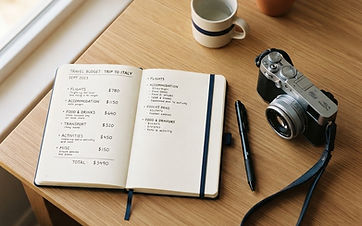
| Category | Cost (AUD) | |---|---| | Flights | $1,200 | | Accommodation | $900 | | Food | $700 | | Transport | $200 | | Activities | $400 | | Insurance | $150 | | Miscellaneous | $150 | | Emergency reserve | $370 | | Total | $4,070 |
Step 3: Convert to the trip currency
Once you have the total in AUD, convert it to the trip currency using the current exchange rate. This gives you your spending budget in the currency you'll use.
The exchange rate
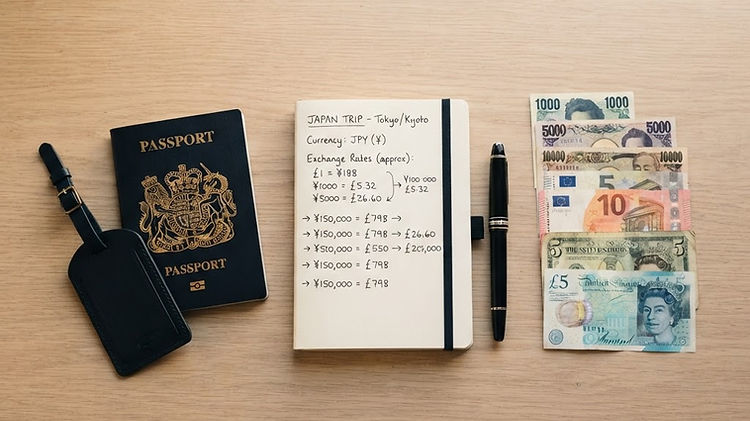
Find the current rate at XE.com or your bank's app. For example, if 1 AUD = 95 JPY, then $4,070 AUD = about 386,650 JPY.
Account for fees
The exchange rate you see online is the mid-market rate — the rate banks use between themselves. You won't get this rate when you exchange money. You'll pay:
- A margin on the exchange rate: typically 1–3% below the mid-market rate.
- A transaction fee: a fixed fee per transaction, or a percentage fee.
So if the mid-market rate is 95 JPY, you might get 92 JPY — a 3% margin. Your $4,070 becomes about 374,440 JPY instead of 386,650. That's a difference of 12,000 JPY ($127) — real money.
How to minimise fees
- Use a travel card: Cards like Wise, Revolut, or your bank's travel card offer rates close to the mid-market rate with low or no fees.
- Avoid airport exchanges: they have the worst rates and highest fees.
- Use ATMs in the destination: but check your card's foreign ATM fees. A travel card usually has lower fees than a standard bank card.
- Pay in the local currency: when given the choice at a shop or ATM, always choose to pay in the local currency, not AUD. The shop's conversion rate is almost always worse than your card's.
Step 4: Build the travel sinking fund
Once you know the total cost, start saving. A travel sinking fund is the most effective way to save for a trip without affecting your everyday budget. See our guide to sinking funds.
Calculate the per-pay contribution
- Total cost: $4,070
- Months until the trip: 10
- Monthly contribution: $407/month
- Fortnightly contribution: $204/fortnight
Set up an automatic transfer to a "Travel" savings account every payday. The fund builds up over time, and the money is there when you need to book flights and accommodation.
Book in advance to lock in prices
Some costs (flights, accommodation) are cheaper when booked in advance. As your sinking fund builds, book these early to secure the best prices — you don't need the full amount saved before you book, but you need enough for each booking as it comes.
Step 5: Track spending during the trip
Once you're on the trip, track your spending in the trip currency to stay within budget.
The daily budget
Divide your total spending money (total minus flights and pre-booked costs) by the number of days:
- Total spending money: $2,870 (total $4,070 minus flights $1,200)
- Days: 14
- Daily budget: $205/day, or about 19,500 JPY/day
Track daily
Use a simple tracker — a notebook, a notes app, or a spreadsheet on your phone. Each day, record what you spent. This keeps you aware of whether you're on track.
Adjust as you go
If you spend more than the daily budget one day, spend less the next. If you spend less, you can afford more later. The daily budget is a guide, not a rule — but tracking keeps you honest.
Step 6: Manage exchange rate risk
Exchange rates change. If the AUD weakens against the trip currency, your trip becomes more expensive. If it strengthens, it becomes cheaper.
Strategies
- Load a travel card in advance: if you load the card with the trip currency at the current rate, you lock in that rate. This protects you if the AUD weakens. But if it strengthens, you miss out on the better rate.
- Load gradually: convert small amounts over time. This averages out the rate (dollar-cost averaging) and reduces the risk of converting everything at a bad time.
- Keep some AUD for the end: don't convert your entire budget at once. Keep some in AUD and convert as needed, so you can take advantage if the rate improves.
How much to worry about this
For most trips, exchange rate movements of 2–5% are normal and won't dramatically change your trip. Don't obsess over the rate — but be aware of it, and use a travel card to minimise the fees and margin.
Step 7: Handle the unexpected
Travel has unexpected costs — a missed train, a medical bill, a lost item. Your emergency reserve (10% of the total) covers these. If you don't use it, it's extra money when you get home — a bonus, not a waste.
Travel insurance
Travel insurance is essential for international trips. Medical care overseas can be extraordinarily expensive — a hospital stay in the US can cost tens of thousands of dollars. Travel insurance covers medical emergencies, trip cancellations, lost luggage, and other risks. Don't skip it.
Common multi-currency budgeting mistakes
- Not accounting for fees. The exchange rate you see online isn't the rate you get. Account for a 1–3% margin and any transaction fees.
- Exchanging at the airport. Airport exchange booths have the worst rates and highest fees. Use a travel card or an ATM in the destination.
- Paying in AUD overseas. When a shop offers to charge you in AUD, say no. The shop's conversion rate is almost always worse than your card's.
- Not having an emergency reserve. Unexpected costs happen on every trip. Without a reserve, you'll stress about every expense.
- Not tracking spending. It's easy to lose track of spending in a foreign currency because the numbers don't feel real. Track daily.
- Budgeting in AUD only. If you only budget in AUD, you won't know whether 2,000 JPY for a meal is expensive or cheap. Know your daily budget in the trip currency.
How Payday Compass helps
The Payday Compass app has a Travel Money module that handles multi-currency budgeting:
- Set the trip currency: choose from 150+ currencies
- Enter the exchange rate: the app converts between home and trip currency
- Track the travel sinking fund: see the fund build toward the total
- Track trip expenses: record expenses in the trip currency, with automatic conversion to AUD
- See the remaining budget: the app shows how much you have left, in both currencies
For a quick check on how much you can save per pay toward a trip, use the free payday calculator.
Summary
Multi-currency budgeting means planning the total cost in your home currency, converting it to the trip currency (accounting for fees), building a travel sinking fund, tracking daily spending in the trip currency, and managing exchange rate risk. Use a travel card to minimise fees, always pay in the local currency, and keep an emergency reserve. The key is knowing your daily budget in the trip currency so you can spend naturally without constantly converting — and tracking daily to stay within it.
To plan and track a trip with multi-currency support, try the Payday Compass Travel Money module.
Put it into practice
The Payday Compass workbook brings these ideas together in one organised spreadsheet.
Explore the Budget Planner